FHSD Unpacked: Fast Finance Facts
Forest Hills School District is proud of our long commitment to providing a world class educational experience at a reasonable cost to taxpayers. That critically important focus of district operations is the subject of the fourth edition of the 2025-2026 FHSD Unpacked series—a publication meant to provide a deep dive into important topics, programs and priorities across Forest Hills.
Return on Investment
Students and residents in FHSD benefit from impressive academic performance ratings, which the district is able to achieve at a below average cost per pupil. This return on investment is indicative of conscientious efforts to deliver robust, high quality educational experience while maintaining a responsible approach to spending.
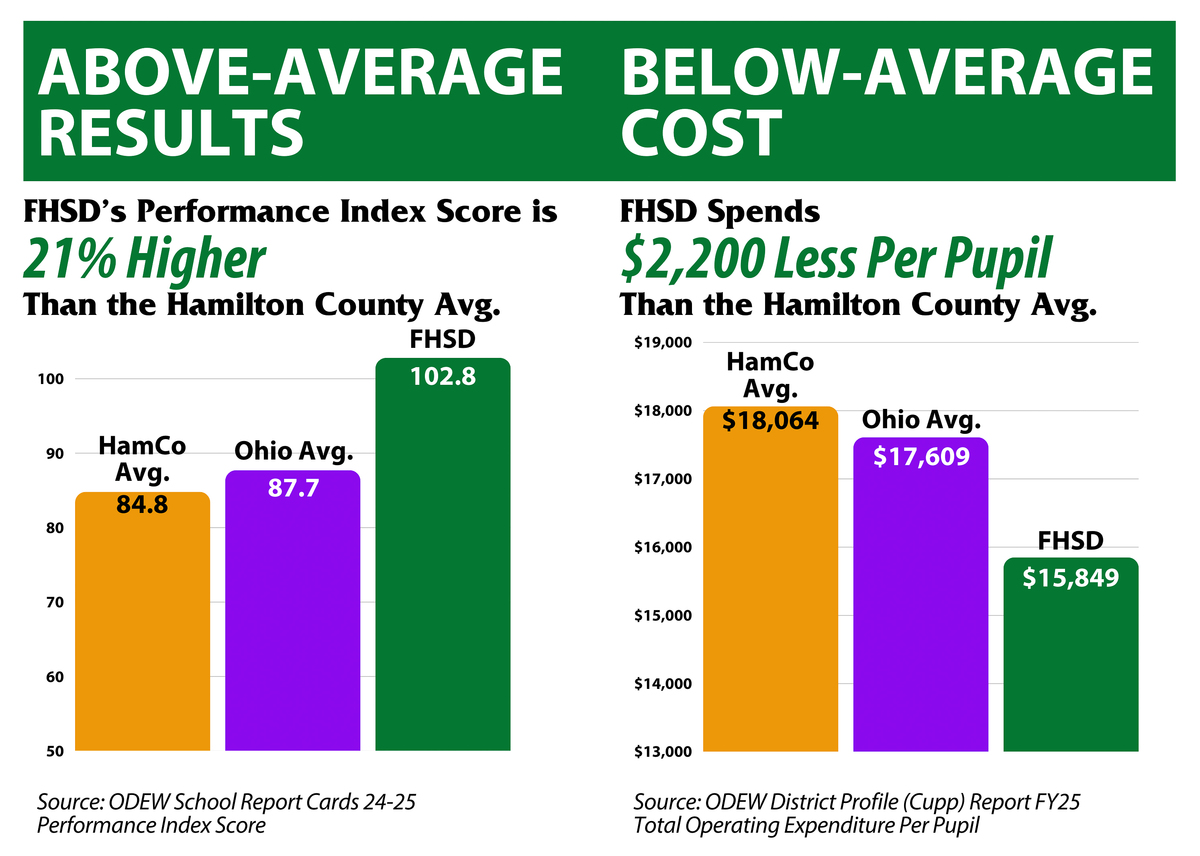
As indicated in the charts pictured below, FHSD's Performance Index Score (a measurement on the Ohio School Report Card) is 21% higher than the Hamilton County average. In the latest report card, FHSD earned a 102.8, while the county average is 84.8 and the state average is 87.7. Additionally, FHSD spends approximately $2,200 less per pupil than the average school district in Hamilton County. According to the total operating expenditure per pupil figure in the District Profile (Cupp) Report, FHSD spends only $15,849 per student. The Hamilton County average is $18,064 and the average across Ohio is $17,609 per student.
Both of these measurements are published by the Ohio Department of Education and Workforce.
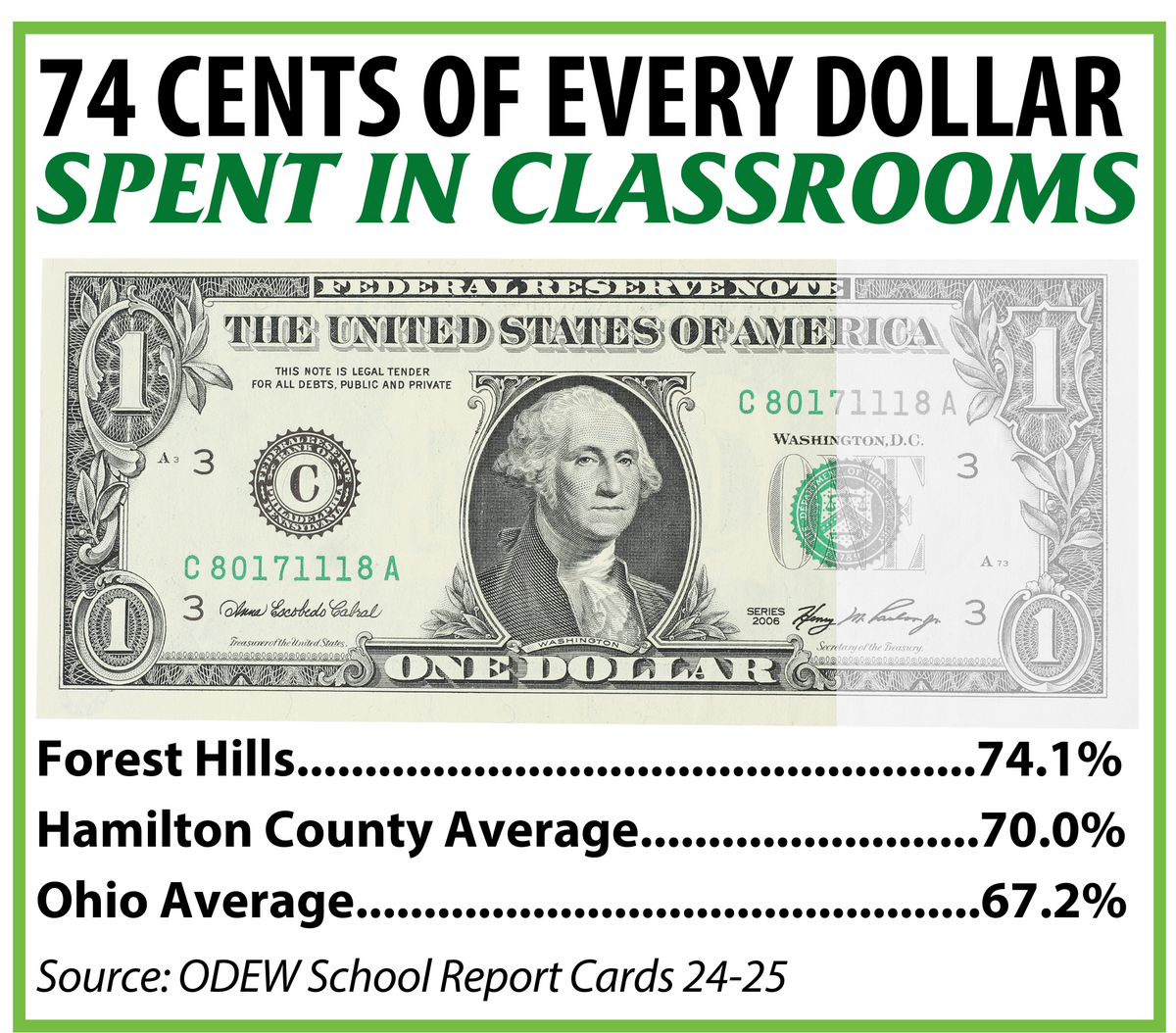
In addition to consistent efforts to keep operational costs low, FHSD uses a higher percentage of those funds directly on classroom instruction. The Ohio School Report Card provides information about how each school district in the state uses its funds, and FHSD is proud to commit a higher percentage of taxpayer funds directly to the classroom (74.1%) than the average district in Hamilton County (70.0%) or the state of Ohio (67.2%).
Forest Hills School District truly understands and deeply appreciates our responsibility to be effective stewards of public dollars. It is a testament to our dedicated staff that these benchmarks can be met while still delivering a very highly-rated education to students.
Financial Forecast Report
Twice each school year, FHSD publishes a Financial Forecast Report that provides a detailed look at current and projected information related to the district's General Fund. This accounts for a sizable majority of the district's total annual budget.
By analyzing past financial trends, currently available data points and anticipated future changes to revenue and expenditures, Treasurer Alana Cropper compiles the information into the Financial Forecast Report. The report follows specific parameters and requirements laid out by the state of Ohio and serves as a planning document to assist with fiscal management and accountability.
The latest Financial Forecast Report was presented to the Board of Education in February. Please click here to learn more about the process and see a snapshot of the district's (projected) financial future.
School Funding Breakdown
Public school districts in Ohio are primarily funded in three ways:
- Federal Government
- State Government
- Local Support
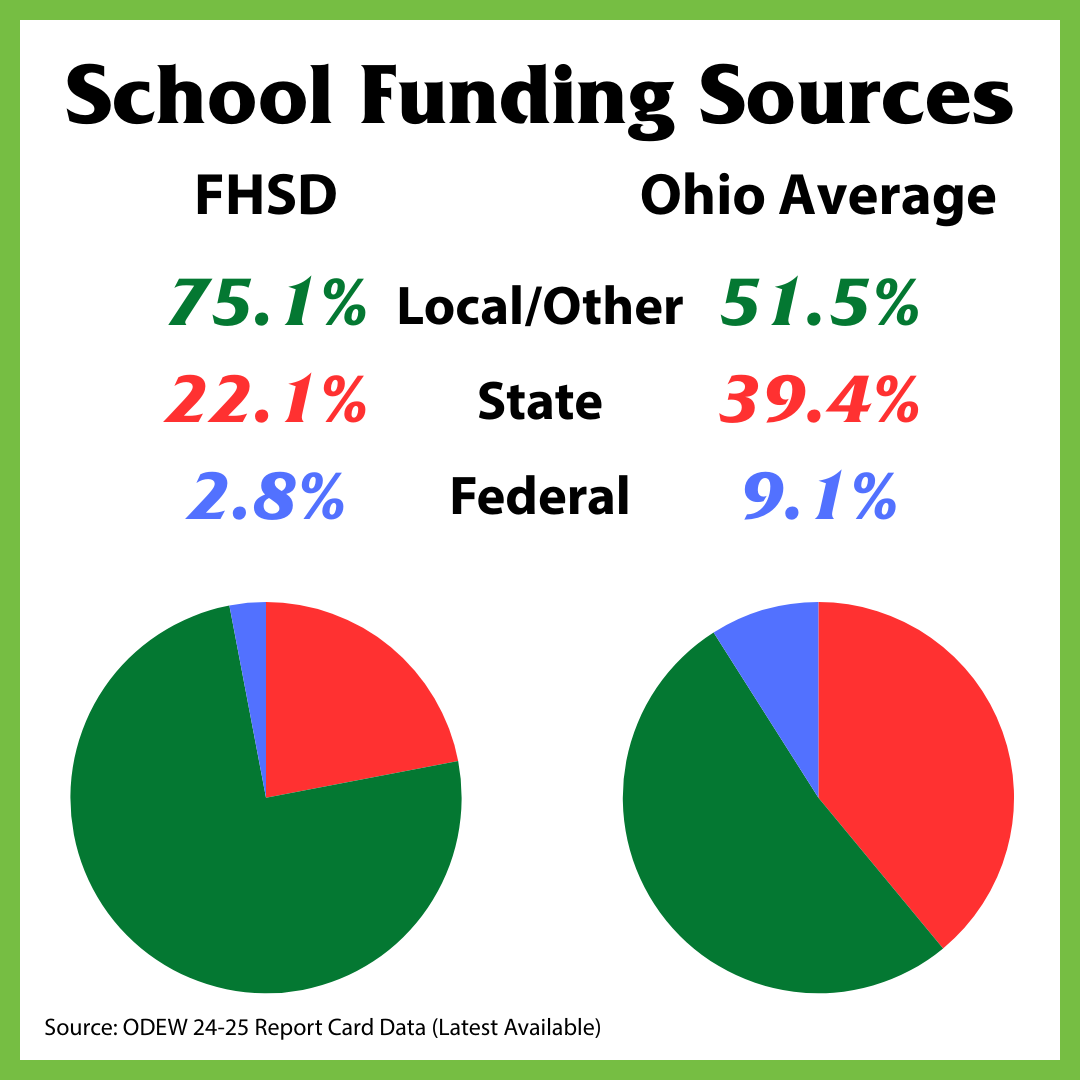
For FHSD, federal funding only accounts for 2.8% of the total budget. State funding is a more significant source of revenue for the district, however in FHSD the portion of state revenue in our overall budget is much lower than the average school district in Ohio.
State funds account for 22.1% of FHSD's total budget, but the average school district in Ohio receives 39.4% of its budget in state dollars (ODEW School Report Cards 24-25). The specific state funding formula is complicated and can change year-over-year. Despite the Ohio Supreme Court finding the funding system unconstitutional in 1997, the legislature has not given it the "complete systematic overhaul" required by the Court since that finding.
This reality for FHSD means that local taxpayers provide the majority of funding that ensures students in our community receive a high-quality education and are given the ability to excel in and out of the classroom.
Understanding the Impact of State Legislation on Tax Levies
A key piece of legislation that has a significant impact on school funding is House Bill 920, passed in 1976 during a period of historically high inflation. This law freezes funding for traditional levies to the dollar amount originally approved by voters and does not permit any increases for these tax levies. As operational costs increase year-over-year due to inflation (energy, gas, supplies etc.), tax revenue for school districts remains flat. This is a major reason why public school districts across the state have to place tax levies on the ballot every several years.
The Ohio Legislature recently passed two laws that are having a negative impact on tax revenue for public schools across the state. House Bill 129 and House Bill 186 are intended to provide property tax relief to homeowners by changing aspects of local tax levies specific to school districts. HB 129, for example, eliminates emergency and substitute levies and makes them subject to the restrictions of HB 920.
This bill is not anticipated to have much impact for FHSD because all of the current voted tax levies are already subject to HB 920, meaning this type of property tax relief has long been in place for residents in Forest Hills. HB 186 deals directly with school districts on the 20-mill tax floor, which FHSD is not.

Community Support and Partnerships
FHSD is fortunate to have a supportive and involved community that does so much to enhance the student experience each and every day. It would not be possible to provide students with the robust, state-of-the art academic, artistic, extracurricular and athletic opportunities they benefit from today without financial and volunteer support from this community.
The Forest Hills Foundation for Education is a critical partner that provides funds to enrich the educational experience of all students in the district, touching all nine schools with intentional programming that enables students to compete successfully now and in the future. FHFE's grant funding goes toward a wide-variety of projects that make it possible to offer next level academics, mental health resources, wellness support and so much more!
Other support organizations like the school Parent Teacher Organizations, booster groups and dedicated organizations like 9United also make a significant difference in the lives of students. By helping fund school-specific projects, technology and enhancements to benefit music, theater and the arts, improvements to athletic facilities, resources for families in need and more, every aspect of our schools are improved by these invaluable community leaders! Thank you booster and PTO members and all individuals who volunteer their time or donate to support students in FHSD. These supplemental funds are critical to providing enhanced opportunities that improve student learning and other important areas.
The district's multi-year Sports Medicine and Wellness partnership with OrthoCincy and The Christ Hospital has been a huge benefit to students interested in medical fields and student-athletes at our middle and high schools. In addition to providing expert athletic trainers and team doctors to support Nagel, Anderson and Turpin, the partnership also includes significant financial contributions benefitting district athletic programs and facilities.
The success of Forest Hills School District and the outstanding academic outcomes for students are only possible through the generous support of volunteers and donors who choose to support the district and all of these valuable partners.
Rooted in Strategy
The FHSD Strategic Plan is a critical, guiding document that sets a strong vision for the future of Forest Hills by continuing to refine and enhance academic opportunities to help students excel now and in the future.
One of the five key strategies is dedicated entirely to operating the school district in a fiscally responsible manner. FHSD is committed to providing an unmatched education to the next generation while also maintaining reasonable costs to the community.
Strategy Four: Demonstrate responsible, efficient, equitable and transparent stewardship of taxpayer investments.
4.1. Prioritize available resources to maximize student growth and personal success.
4.2. Support evolving educational and facilities needs in a fiscally responsible manner by seeking regular stakeholder input.
4.3. Routinely evaluate the efficiency and effectiveness of all programs, policies and procedures.