Money Matters: FHSD Presents Fall 2026 Financial Forecast
During the August 19, 2026 Board of Education Meeting, Forest Hills School District Treasurer Alana Cropper presented the district’s annual Financial Forecast Report. This document provides detailed information about the finances of the General Fund, which accounts for approximately 80.2% of FHSD’s total annual budget.
Responsible Financial Planning
The Financial Forecast Report serves as a planning document to assist with fiscal management and accountability by showing historical and projected revenue and expenses. The district publishes the initial report in August with an update in February, both of which are presented during public meetings of the Board of Education. The document used to be called the Five-Year Forecast and was traditionally presented to the Board of Education every November and May, but recent changes in state law have modified the length of the projections and the deadlines to submit the report to the state of Ohio.
The forecast is designed to adjust over time to reflect changing factors that impact the district’s finances, which is why the report is presented twice every school year. For example, this version of the financial forecast takes into account all additional data that has become available since the previous update was presented in February 2026.
You can click the following links to view the official copy of the August 2026 Financial Forecast Report and related materials:
- Financial Forecast Report August 2026 (FY27-FY31)
- Video of Treasurer Cropper’s Presentation to the Board of Education
- Slideshow Presentation of the August 2026 Report
You can find additional information about the financial forecast by visiting the district’s dedicated webpage to the document here. In completing the Financial Forecast Report, FHSD, like other public school districts in Ohio, follows specific parameters and requirements laid out by the state of Ohio. You can learn more about the process on the state’s website here.
Updates from Most Recent Forecast
Treasurer Cropper provided a summary of revenue and expenditure variances between the current Financial Forecast Report and the most recent version. When comparing actual data from Fiscal Year 2026 (July 1, 2025 to June 30, 2026) to the projections included in the February report, the district saw total actual revenue exceed projected revenue by $613,759 (0.6%). In terms of expenditures, the FHSD General Fund came in under the expected amount by $750,720 (-0.7%), and those figures represent a positive change in the ending cash balance by a total of $1,364,481. The higher than projected revenue is due largely to Tax Increment Financing (TIF) payments, and those changes were calculated into future projected revenues. The smaller than projected expenditures are due to efforts across departments to reduce costs and operate more efficiently, and these cost savings were also trended forward in the updated forecast.
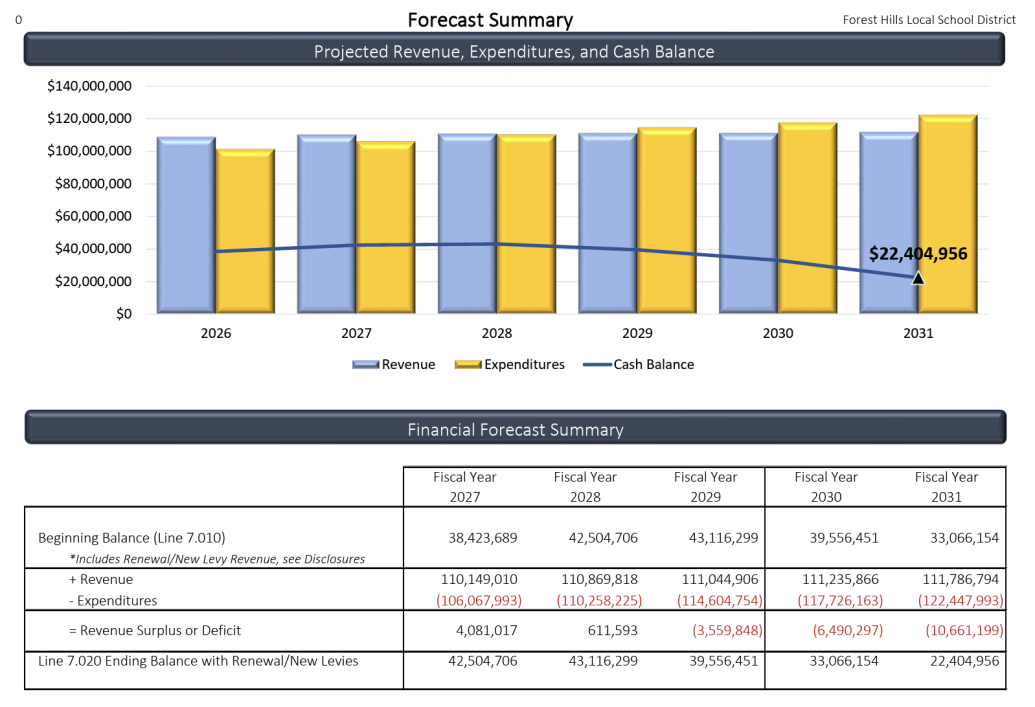
The updated forecast projects relatively consistent General Fund revenues between fiscal years 2026 and 2031. With expected increases in expenditures due to inflationary increases in the cost of items like food, fuel and energy, and negotiated cost of living adjustments in salary and benefits, the forecast projects the General Fund cash balance to begin to see a decrease between the 2028 and 2029 fiscal years. General Fund expenditures could exceed revenues as early as fiscal year 2029.
How the Forecast is Created
The district’s General Fund, which is the primary focus of the financial forecast, is used to pay for things like staff salaries and benefits, purchased services from outside contractors and supplies and materials that support classroom education, supporting the majority of the day-to-day operations for FHSD. Other funds include permanent improvement, food service, bond retirement and more (and these funds are NOT included in the financial forecast as stipulated by state law).
In creating the Financial Forecast Report, Treasurer Cropper evaluates past trends for known data points, adjusts calculations to match known historical data and makes predictions for key variables that could impact future finances. The report contains information about those key assumptions and provides additional notes when such predictions are utilized. Some specific items entirely outside the district’s control that can have a noticeable impact on the forecast include changes to the amount of state funding, property valuations and revisions, legislative mandates, economic inflation and more.
It is important to remember that any changes or adjustments at the state level in regards to school funding can rapidly change projections in the forecast between updates. Ohio will welcome a new governor during Fiscal Year 2027 (July 1, 2026 to June 30, 2027), and the state biennial budget process that follows could also have a significant impact on the financial forecast projections.
The forecast is simply the district’s best estimation as to what might happen in the future. Many variables that affect the financial forecast are currently unknown and out of the district’s control (i.e. state funding and economic inflation), and the forecast will be updated as those unknowns become known. Despite those challenges, Forest Hills School District remains committed to responsible fiscal planning and regularly evaluates internal processes and procedures to find ways to operate as efficiently as possible.
Other Important Financial Considerations
Ongoing conversations at the state level to look at property tax relief may also play a role in future financial planning for school districts across Ohio. The district will pay close attention to these discussions and proposals in order to provide accurate information about potential impacts on our local community.
One existing law in particular plays an important role in school finance by keeping the majority of school district tax revenue flat year-over-year. In 1976, House Bill 920 became law and has led to most school districts in Ohio returning to residents to request additional funds through tax levies. This law forces voted property tax revenues for school districts to stay the same year over year, because it does not account for inflation. Other governmental entities at the state, county and municipal level rely primarily on either income tax revenue (which increases as wages increase) or sales tax revenue (which increases as inflation drives up the cost of goods and services). However, as property values go up, the school tax rate is actually lowered by the county auditor to ensure no additional revenue is collected.
While the district does not anticipate the need for a tax levy in the immediate future, the reality of current laws and the projected decrease in the General Fund cash balance toward the end of this financial forecast will both play a role in future conversations around school funding in Forest Hills School District.